Renewing Your Mind

“Do not be conformed to this world, but be transformed by the renewal of your mind, that by testing you may discern what is the will of God, what is good and acceptable and perfect” (Romans 12:2)

In his letters, Paul always combined theological teaching with application for life. As he concluded what are the first eleven chapters of Romans, he began chapter twelve with a call for those in the church to respond in thankfulness to God’s redeeming work. He said this would be their “spiritual worship” (Romans 12:1). He then exhorted them to have a mind-set shaped by the gospel and the power of the Holy Spirit rather than the world. It was a call to discern the will of God. That call is the same for us today.

Paul is not the only one who emphasized the need to be cautious of the world’s influence. James wrote that “friendship with the world is enmity with God” (James 4:4). The apostle John warns us not to love the world or the things in the world, and that if we do the love of the Father is not in us (1 John 2:15). As Christians, we must have a proper perspective when it comes to our relationship with the world.

It’s no surprise that in large part, the world in which we live operates in opposition to God. Our culture desires to shape our thinking, and it will unless we allow God’s Word to. Spiritual nourishment, feeding on God’s Word daily cannot be an option if we are to stand strong against the world’s influence. However, its value to us is much greater than that. Consistent fellowship with our Lord helps us to live out the joy God intends for us, the joy that a relationship with Christ brings. As much as we were saved from an eternal hell, we were also saved to an abundant life in Christ. God desires intimate fellowship with us. Paul knew that to be true in his day. And it’s just as true today. Don’t let the anxiety of the world and its influence rob you of what God has promised. Seek God and His truth each day, be transformed by the renewal of your mind so you may live out that truth in a world that largely stands in opposition to His will. After all, this world is not really your home.
Cornerstone

“therefore thus says the Lord God, ‘Behold, I am the one who has laid as a foundation in Zion, a stone, a tested stone, a precious cornerstone, of a sure foundation: Whoever believes will not be in haste’” (Isaiah 28:16)

The New Year always seems to be an appropriate time to reassess the past and perhaps reorder our priorities. It just seems the right time to consider necessary changes as we move forward into the future. The first Sunday of the New Year, our pastor taught from the beginning verses of Isaiah 41. I’m not sure whether the passage was chosen specifically for the first Sunday, but it was certainly an appropriate one. In his sermon, he encouraged us to know and experience both the greatness of God and His presence in our lives. One of the primary passages in the text was Isaiah 41:10, “Fear not, for I am with you; be not dismayed, for I am your God; I will strengthen you, I will help you, I will uphold you with my righteous right hand”. In this same service we sang several songs whose themes aligned with what was taught. One of the songs was Cornerstone, a remake of an old hymn written in 1834, known today as “The Solid Rock”. The song has an updated chorus that was written and recorded by several members of the worship group Hillsong, and was born out of a mass shooting that took place in Norway in 2011. In an interview about what inspired the song, one of the co-writers indicated that circumstances such as this shooting are reminders that when everything appears to be shaken and nothing seems to make sense, we really need to put our faith in Jesus, the Cornerstone.

In ancient building practices, a cornerstone was the large stone that served as the foundation for the entire structure. It was a special piece that needed to be perfectly set. In a figurative sense, a cornerstone is the thing we build our life around. It is what we value the most. It is what we prioritize. It is what we say “no” to other things for because we have said “yes” to it, and of course, it is what we stand on in times of uncertainty. When speaking about the Lord, we find the image of a stone or rock used in both the Old and New Testaments. The point of Isaiah 28:16 is that God has established a sure foundation for His people, a sure foundation that the Old Testament points to and the New Testament reveals. This sure foundation is Jesus Christ. Peter referred to Christ as a “living stone” as He is both the source and giver of eternal life. Those who trusted in Him he called “living stones” (1 Peter 2:4-5). For those who rejected His Word, Jesus became a stone of stumbling (1 Peter 2:8). He is a stone of stumbling for those who reject Him today.

As years pass, the pace at which they go seems only to increase. That begs the question, not because it’s the New Year, but because the answer has eternal consequences. Is Christ your cornerstone? Have you put your trust in Him? Is He your priority? Is He the “rock” upon which you stand? Maybe this is the year to make some changes and put Jesus in His rightful place. In this New Year, why not try standing on the solid rock of Christ, because the truth is, all other ground really is just sinking sand.

Anchor Deep

“…so that we may no longer be children, tossed to and fro by the waves and carried about by every wind of doctrine, by human cunning, by craftiness in deceitful schemes. ” (Ephesians 4:14)

We should never think the work of ministry is only for those who do it vocationally. That’s not found in Scripture. We are all “ministers” with a role and responsibility to spread the gospel. The reason Paul says God gave the apostles, prophets, evangelists, shepherds and teachers was that they would equip the saints (all Christians) for the work of ministry and for building up the body of Christ (Ephesians 4:11-12).

There is a purpose for equipping of believers. Ultimately, that purpose is that we would bring God glory. This happens as we live out His will in our lives. God’s glory should always be our primary goal. But growing in maturity also helps us navigate through a challenging world. We need a filter through which to see the world, an anchor to keep us from being tossed about by false teaching.

Our world promotes many non-biblical ideas. Some may even sound good on the surface, but in the end just get us off course. Paul explains in Ephesians 4:14 that spiritual maturity is important because it keeps us from being like a ship without an anchor as wave’s crash in and the wind blows around us. It helps us to better be able to choose right instead of wrong and less likely to follow where we shouldn’t. So, make sure to anchor deep that you may more fully discern the will of God. Search His will in His Word. Doing so will benefit you as you navigate in a crazy and confused world. Most importantly, it will bring God the glory He deserves.

Right in Our Own Eyes

“In those days there was no king in Israel. Everyone did what was right in his own eyes” (Judges 21:25)

This last verse of Judges pretty much sums it up. The people set the rules. Though Israel’s drift away from God had already begun, by the time of the judges, their turning away was pretty well complete. The book of Judges was written around 1043 B.C. just after Saul, Israel’s first king, began his reign and spans a period of about 350 years. It is one of the twelve “historical books” books of the Bible. Though its author is unknown, they are thought to be a loyal supporter of David.

“And the people of Israel did what was evil in the site of the LORD…” These words are written numerous times in the book of Judges (2:11; 3:7; 4:1; 6:1; 10:6; 13:1). Israel was in both a moral and spiritual decline. Their disobedience was rampant. They refused to drive their enemies from the land, they committed idolatry, they refused to listen to the advice of the “judges” and they turned away from God after the particular judge’s death. The result of their disobedience was conflict and turmoil. God, however, was gracious, and when Israel expressed their desperation and acknowledged their sinfulness, He would send another judge to deliver them. This pattern played itself out over and over again during this period.

Too often we want to do what is right in our own eyes without proper concern for God’s will. This never gets us very far and it is only when we reap what we have sown that we acknowledge our sinfulness. The truth is we are not too different from Israel in that regard. But thankfully, our God is different and in the book of Judges we see His character on full display. Yes, God is righteous, wrathful and just. There were consequences that resulted from Israel’s disobedience. There are consequences that result from our disobedience as well. But our God is also a loving God. He is merciful and gracious, and just as He heard Israel’s cry, He also hears ours. And just as He delivered them from their failures time and time again, He stands ready to deliver us from ours. We will spend our lives learning more and more about God’s character. As we do, let us call on the power of the Holy Spirit to help us lead lives in submission to God’s will. Let us do what is right in His eyes only.

To Your Name Alone

“Not to us, O LORD, not to us, but to your name give glory” (Psalm 115:1)

God’s greatest desire is to be glorified. It was also Jesus’ greatest passion. G. Campbell Morgan once wrote, “The deepest passion of the heart of Jesus was not the saving of men, but the glory of God; and then the saving of men, because that is for the glory of God”. In church, we talk a lot about God’s glory, but the truth is it’s hard to define. The most common word for glory in the Old Testament is the Hebrew kabod, which means “heavy in weight”. In the New Testament it is the Greek word doxazo, which means “to magnify, praise or hold in honor”.

As humans, we are incapable of adding to or taking away from God’s inherent glory. However, we are called to respond to it. Matthew 5:16 says, “Let your light shine before others, so that they may see your good works and give glory to your Father in heaven.” God has done amazing things for us in Christ. By His grace, He has saved us. If we are to be about God’s glory, we must have as our central goal to make Him look as glorious as He is. We don’t do this privately, but in full view of the world. We also don’t do this in our own strength, but in the strength supplied by the Holy Spirit as we seek God in His Word.

Our God has done great things! Let us live and speak in such a way that honors the reality of who He is and what He has done. He deserves nothing less. Seek Him each day and let His light shine in you, never for your glory or mine, but always and only for His.

Winning Either Way

“For me to live is Christ, and to die is gain” (Philippians 1:21)

In Romans 6:3-10, Paul uses baptism as a metaphor to teach about the believers union with Christ. He says in verse 4 that we were buried with Christ by baptism into death and raised to walk in newness of life. Fast forward three years where we find Paul sitting in a Roman prison. It was the first of his two imprisonments in Rome and the location from which he wrote four letters, including one to the church at Philippi. It’s always been interesting to me that Paul’s letter to the Philippians, a letter written from prison would be considered his most joyful letter, but it is. Paul found great joy in serving Christ. His was an inward joy that was unaffected by circumstance.

There are certainly implications of having the gospel in our lives. The apostle Paul was completely sold out to Christ. From the time of his conversion, everything he did and everything he incurred was for the sake of advancing the gospel. As a result, he found himself in some difficult situations. Paul knew there would be consequences for his commitment to Christ, but he also knew that ultimately, his was a win-win situation. He would either be released to continue his ministry, or should he die, it would only deepen his union with Christ.

The apostle Paul is great example of many things. He is not only a wonderful example of God’s grace, but also of the supernatural work of the Holy Spirit in the life of a believer. As committed as he was to the persecution of Christians before his conversion, he was equally committed to proclaiming Jesus after it. Are you that committed to Jesus? Am I? Is ours a view that there’s much more to look forward to than what we see? Do we really believe that this life is only preparation for the next? God has done amazing things for us in Christ. Let us live in light of that truth with the full understanding that our union and our destiny are secure. And because they are, let it influence our commitments today.

Being Christian

“The natural person does not accept the things of the Spirit of God, for they are folly to him, and he is not able to understand them because they are spiritually discerned” (1 Corinthians 2:14)

Mahatma Ghandi once said, “I like your Christ, but I do not like your Christians. Your Christians are not like your Christ”. When I first heard this quote, I was intrigued as to why Ghandi might have said this. What is it he doesn’t understand? The point the Apostle Paul is making in 1 Corinthians 2:14 is that non-Christians will never understand the message of the cross because it’s only the Holy Spirit that allows humans to comprehend its message.

Though Ghandi’s quote clearly lacks of a true understanding of what it is to be Christian, it does give pause for us as Christians to consider our witness to an unbelieving world. I think perhaps what he meant by his quote was that he sees no distinction between those who call themselves Christian and those who aren’t. Unfortunately, many have bought into the cultural definition of Christianity; a definition that has no expectation that a changed life follows a changed heart, a definition that fails to recognize that Jesus’ dealing with sin on the cross wasn’t so we would remain in it, a definition that expects God’s standards to conform to ours instead of ours to His. This definition not only falls short of the biblical one, it’s not even Christian.

On the other hand, it shouldn’t surprise us when non-Christians fail to understand or accept what it is to be Christian. They can’t. They may have their own misperceptions of what it means. They might even call it religion. Christianity has never been about the perfect Christian, but instead about trusting in the perfect Savior who made a perfect sacrifice for sin, Jesus. It’s about His faithfulness, not ours.

There will always be a disconnect between Christians and non-Christians. So don’t be shocked when you find the non-Christians comments to be antagonistic and their criticism great. We must minister as Paul urged Timothy when he wrote telling him to “not be quarrelsome but kind to everyone, able to teach, patiently enduring evil, correcting opponents with gentleness that God may perhaps grant them repentance leading to knowledge of the truth…” (2 Timothy 2:24-25). This may be a hard course, but it’s the right course. It doesn’t mean you deny biblical authority, compromise your beliefs or tolerate ungodliness. It simply means that you live out who God calls you to be, share the good news of Jesus Christ and rely on the Holy Spirit for the rest.

Why Understanding the Doctrine of Sanctification Matters

“…work out your own salvation with fear and trembling, for it is God who works in you, both to will and work for His good pleasure” (Philippians 2:12-13)

Regeneration is an act by which God renews the human heart. We often hear it expressed as being “born again”, “made alive” or “made new”. Regeneration’s natural progression is to faith and repentance on the part of man. Justification is to be declared not guilty, to have a right legal standing before God because Christ’s righteousness has been imputed to us. Author and theologian, John Murray says “regeneration is an act of God in us, whereas justification is a judgment of God with respect to us.” Regeneration, justification and our adoption into God’s family is a work of God’s grace alone. Though not the primary subject here, these doctrines are important to our understanding the doctrine of sanctification and why understanding it matters.

So What is Sanctification?

In his book, Systematic Theology, Wayne Grudem defines sanctification as a work of God and man that makes us more and more free from sin and like Christ in our actual lives. Sanctification is viewed in two ways: First, having been “set apart” for God’s holy purpose, it is viewed as a past event. This is referred to as positional sanctification. Secondly, sanctification is viewed as a continual transformation over time. This has been termed progressive sanctification. It is important for us to understand the difference. As a Christian, our position before God is perfect. When He looks at us, He sees the righteousness of Christ that has been placed on us. However, God also knows we are a work in progress. He knows that  in this life we will never be perfect, but that by the indwelling power of the Holy Spirit we are being transformed more and more into the image of Christ (2 Corinthians 3:18). This transformation will not end until glory.

How Understanding Sanctification Helps Us in Our Christian Walk

So, why does understanding the doctrine of sanctification matter? There are several reasons: First, it helps to keep us from being defeated by our sin. On the cross, Jesus dealt with sin for all time—past, present and future. Understanding that there is a progressive aspect to our spiritual maturity helps to keep us from being overwhelmed by guilt that results from sin. We are never perfect in this life. It’s not that we don’t want to be, and shouldn’t want to be. And it’s not to make light of sin. It’s just how it is. Satan would love for us to be consumed with guilt because it has the potential of rendering us ineffective in gospel ministry. Remember, Jesus took the sin and all that goes with it.

Secondly, understanding the doctrine of sanctification makes us more effective as we minister in that it helps us to be more patient with others. People are always at different places in their walk with Christ and understanding that there is an ongoing spiritual progression in each of us allows us to meet people where they are, to better understand them and encourage them as they grow in grace.

Lastly, understanding the doctrine of sanctification brings glory to God. Doctrines aren’t taught to bring confusion, but to lessen it. They are taught because they matter. They help us take away from God’s revelation what He intended, thereby, enabling us to rest in the grace we find only in Him. This pleases the heart of God and brings Him the glory He is due!

A Repeating Theme

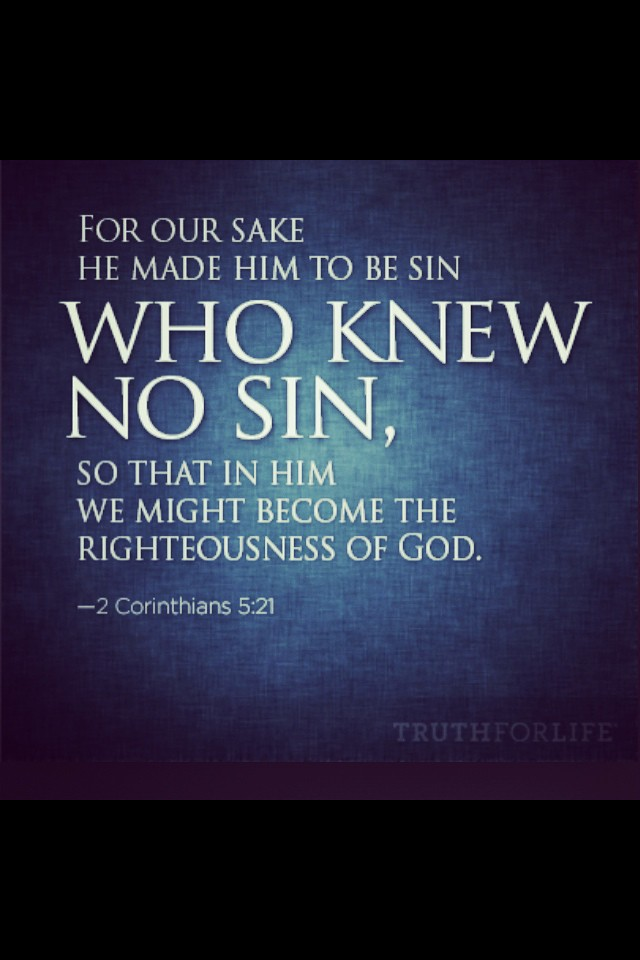
2 Cor 5 21

A theme is defined as the main thrust of what is being promoted, discussed or described. Its purpose is to help people remember the key messages or takeaways from whatever is being talked about. We find prominent themes used for many things such as movies, lectures and writings. We find themes in business, in advertising and in politics. We even find themes in the church as there is often a primary theme for each year, for individual sermons or a sermon series.

Of all the verses in Scripture, I’m not sure there’s a single verse that captures the overall theme of the Bible better than 2 Corinthians 5:21. Personally, it’s my favorite verse. I can still remember when I first grasped the meaning of this verse and the freedom that came with it. That Jesus was my substitute—that He would take the penalty for my sin so I wouldn’t have to just blew me away.

Sometimes in my writing, I wonder if I reference 2 Corinthians 5:21 too much. I wonder if because I love this verse so much, I force its use when it doesn’t belong, where perhaps it doesn’t fit the context of what I’m writing about. But the more I think about it, the truth is, this verse belongs everywhere. Its theme can never be repeated enough. That’s because these twenty-four words take us straight to the cross, the center of all that God has done for us.

There is no greater expression of God’s love than what we find at the cross. On the cross, Jesus not only took our sin, but also the guilt and shame that goes with it. There’s freedom in that, not freedom to sin, but freedom to live in response to His grace. I don’t think we can even begin to fully grasp the depth of God’s love, and for what He has done for us in Christ. Christ’s atoning work has saved us from an eternal hell our sin deserves. But more than that, He has saved us to a living hope, a hope we are to enjoy today, but also to look forward to in its fullness for all eternity.

Through the Word of Christ

“Faith comes from hearing, and hearing through the word of Christ” (Romans 10:17)

God’s Word is so vast that our full understanding will always remain elusive. That’s why He is God. Just as He has foreordained salvation, God has also foreordained the means by which it comes. Romans 10:17 tells us the only way to come to faith is to hear the gospel—the good about Jesus Christ. That was Paul’s message to the Jews. Though many rejected the gospel, Paul continued to proclaim that their salvation came the same way everyone else’s did, through Christ alone. He was all about breaking down the barriers between Jews and Gentiles. They were all one in Christ. Salvation was for anyone who called on the name of the Lord. So, Paul continued to preach.

Romans 10:17 answers the question of why the gospel must be preached, but prior to this verse, with a series of rhetorical questions, he considers the chain of events that lead to salvation, writing, “How then will they call on Him in whom they have not believed? And how are they to believe in Him of whom they have never heard? And how are they to hear without someone preaching? And how are they to preach unless they are sent?” (Romans 10:14-15). Paul went on to make the point that hearing alone wasn’t enough to be saved. They also needed to respond in faith.

We live in a time where fear and discomfort sometimes inhibits our sharing the message of Christ. Let’s face it, when you express the one way of salvation, you risk offending people. But we must be true to the gospel mandate. We must go and tell because the only way for anyone to be saved is to hear and believe. It may be impossible to always know what those we encounter died believing, but we can know if our lives reflected Christ in us, and if we were faithful to share our reason for hope with them. Be faithful to heed the words of Scripture. These are not just words for us to believe, but words to share like there’s no tomorrow. We can never know, for some, there may not be a tomorrow and eternity is at stake.