About Sin

“For all have sinned and fall short of the glory of God” (Romans 3:23)

The fact that we are all sinners is clearly taught in Scripture. Speaking to both Jews and Gentiles, Paul spent the first two and a half chapters making the case that all have sinned and fallen short of God’s glory. Known as the Apostle Paul’s most theological letter, Romans spells out the whole of the gospel more than any other letter. It’s not an accident that in doing so, he began with sin.

There are two dangerous attitudes toward sin that we need to be cautioned against. The first is the attitude that shrugs off sin with words like, “I’m just a sinner; God knows that”. While we are sinners, and yes, God does know that, our attitude toward sin matters. God has commanded us to “be holy, for I am holy!” (1 Peter 1:16). A casual attitude toward sin never brings glory to God. A second dangerous attitude toward sin is an attitude that believes we are incapable of great sin. It is often manifested by judging someone else by saying something like, “I can’t believe what they did. I would never do that.” Be careful, we all have a sin nature and are capable of great sin. If you believe you’re not, you’ll be less likely to guard against it. The Christian life requires discipline. We must train ourselves for godliness (1 Timothy 4:7).

I once heard a sermon where a pastor in preaching to prospective pastors in seminary training said that if in their preaching they do not confront their congregation about sin, it not only brings into question their love for their congregation, but also their love for God. When your pastor confronts you with your sin, be grateful. He’s preaching the Bible. However, also know that the natural extension of confronting you with your sin is for him to tell you of its cure, Jesus Christ. It has been said that “the first act of faith is to believe what God says about sin”. It’s true. And what brings people to saving faith is what God did about it. He gave His Son to pay sin’s penalty. Have you placed your faith in that truth? Jesus really did pay it all. He paid it willingly, perfectly and for all time. After such a display of love, how could we be so casual about what Christ came to cure?
A Repeating Theme

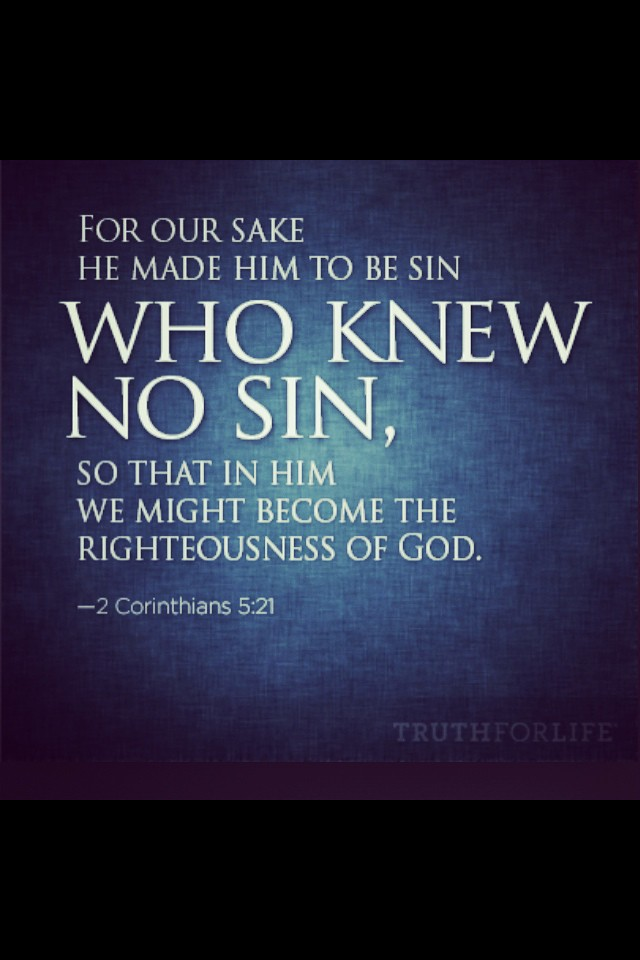
2 Cor 5 21

A theme is defined as the main thrust of what is being promoted, discussed or described. Its purpose is to help people remember the key messages or takeaways from whatever is being talked about. We find prominent themes used for many things such as movies, lectures and writings. We find themes in business, in advertising and in politics. We even find themes in the church as there is often a primary theme for each year, for individual sermons or a sermon series.

Of all the verses in Scripture, I’m not sure there’s a single verse that captures the overall theme of the Bible better than 2 Corinthians 5:21. Personally, it’s my favorite verse. I can still remember when I first grasped the meaning of this verse and the freedom that came with it. That Jesus was my substitute—that He would take the penalty for my sin so I wouldn’t have to just blew me away.

Sometimes in my writing, I wonder if I reference 2 Corinthians 5:21 too much. I wonder if because I love this verse so much, I force its use when it doesn’t belong, where perhaps it doesn’t fit the context of what I’m writing about. But the more I think about it, the truth is, this verse belongs everywhere. Its theme can never be repeated enough. That’s because these twenty-four words take us straight to the cross, the center of all that God has done for us.

There is no greater expression of God’s love than what we find at the cross. On the cross, Jesus not only took our sin, but also the guilt and shame that goes with it. There’s freedom in that, not freedom to sin, but freedom to live in response to His grace. I don’t think we can even begin to fully grasp the depth of God’s love, and for what He has done for us in Christ. Christ’s atoning work has saved us from an eternal hell our sin deserves. But more than that, He has saved us to a living hope, a hope we are to enjoy today, but also to look forward to in its fullness for all eternity.

Come and Rest

“Come to me, all who labor and are heavy laden, and I will give you rest. Take my yoke upon you, and learn from me, for I am gentle and lowly in heart, and you will find rest for your souls. For my yoke is easy, and my burden is light” (Matthew 11:28-30)

Though the Mosaic Law served specific purposes for the Jews, its ultimate purpose was for them to recognize their sin and thus their need of Christ for salvation. The Pharisees, however, taught a sort of self salvation, the thought people had to do something in order to be saved. That’s not what Jesus taught.

A “yoke” is a wooden framework placed over the necks of animals to hold them together in order for them to pull objects. The idea of being under a “yoke” implies being under submission to another. Being bound by the demands of the law was an oppressive burden, a “yoke of slavery” for the Jewish people. In contrast, Jesus’ yoke is easy and His burden light.

It is easy to fall into the false belief that we have to “do something” to earn or keep our salvation. It’s a heavy burden trying to do that. In fact, it’s impossible because salvation can’t be earned. The beauty of the gospel and the words spoken by Jesus in Matthew 11:28-30 is that they make clear the only way of salvation—by grace, through faith, in Christ. Salvation isn’t based on our religious affiliations, a certain set of rituals or our good deeds. It’s based on death, burial and resurrection. Jesus did it all. Honor and glorify Him by resting in His redeeming work.

Through the Word of Christ

“Faith comes from hearing, and hearing through the word of Christ” (Romans 10:17)

God’s Word is so vast that our full understanding will always remain elusive. That’s why He is God. Just as He has foreordained salvation, God has also foreordained the means by which it comes. Romans 10:17 tells us the only way to come to faith is to hear the gospel—the good about Jesus Christ. That was Paul’s message to the Jews. Though many rejected the gospel, Paul continued to proclaim that their salvation came the same way everyone else’s did, through Christ alone. He was all about breaking down the barriers between Jews and Gentiles. They were all one in Christ. Salvation was for anyone who called on the name of the Lord. So, Paul continued to preach.

Romans 10:17 answers the question of why the gospel must be preached, but prior to this verse, with a series of rhetorical questions, he considers the chain of events that lead to salvation, writing, “How then will they call on Him in whom they have not believed? And how are they to believe in Him of whom they have never heard? And how are they to hear without someone preaching? And how are they to preach unless they are sent?” (Romans 10:14-15). Paul went on to make the point that hearing alone wasn’t enough to be saved. They also needed to respond in faith.

We live in a time where fear and discomfort sometimes inhibits our sharing the message of Christ. Let’s face it, when you express the one way of salvation, you risk offending people. But we must be true to the gospel mandate. We must go and tell because the only way for anyone to be saved is to hear and believe. It may be impossible to always know what those we encounter died believing, but we can know if our lives reflected Christ in us, and if we were faithful to share our reason for hope with them. Be faithful to heed the words of Scripture. These are not just words for us to believe, but words to share like there’s no tomorrow. We can never know, for some, there may not be a tomorrow and eternity is at stake.

Why “Being Good” Can’t Be Good Enough

“All have turned aside; together they have become worthless; no one does good, not even one” (Romans 10:12)

I imagine all of us at some point have wished that “being good” was good enough to spend eternity with God. There are people we love that one day leave this world making us wonder if they ever put their trust in Jesus Christ. And even with the best of intentions, we wish God would grant salvation based on their “goodness”. The problem in wishing that is it’s not what the Bible teaches. To think otherwise is to misunderstand the relationship between the Old and New Testaments, to ignore numerous passages of Scripture and to read others out of context. Our beliefs must conform to God’s inerrant Word.

The Bible teaches that we’re saved by faith alone in Christ alone. That is the distinguishing characteristic between Christianity and all other religions. The Bible says that “none is righteous, no, not one” that “no one seeks God” and that “no one does good, not even one” (Romans 3:10-12). And about our righteous deeds it says, they’re like filthy rags (Isaiah 64:6). God really is that holy and we all fall short of the perfect standard He set, “For all have sinned and fall short of the glory of God” (Romans 3:23). But thankfully, God didn’t leave us in that condition. By His grace, He has provided a way of salvation for us in Christ. Our stains have been washed clean by the blood of Christ (Ephesians 2:13). Jesus willingly traded His righteousness for our sin (2 Corinthians 5:21) and by His wounds we have been healed (1 Peter 2:24). This is the message we share. This is the good news. This is the gospel. Let these truths never be lost. Though perhaps we might sometimes wish salvation rested on our goodness, the Bible clearly teaches it doesn’t. Salvation results from one thing—trusting in the finished work of Christ, because, unlike us, He was good enough!