Why Understanding the Doctrine of Sanctification Matters

“…work out your own salvation with fear and trembling, for it is God who works in you, both to will and work for His good pleasure” (Philippians 2:12-13)

Regeneration is an act by which God renews the human heart. We often hear it expressed as being “born again”, “made alive” or “made new”. Regeneration’s natural progression is to faith and repentance on the part of man. Justification is to be declared not guilty, to have a right legal standing before God because Christ’s righteousness has been imputed to us. Author and theologian, John Murray says “regeneration is an act of God in us, whereas justification is a judgment of God with respect to us.” Regeneration, justification and our adoption into God’s family is a work of God’s grace alone. Though not the primary subject here, these doctrines are important to our understanding the doctrine of sanctification and why understanding it matters.

So What is Sanctification?

In his book, Systematic Theology, Wayne Grudem defines sanctification as a work of God and man that makes us more and more free from sin and like Christ in our actual lives. Sanctification is viewed in two ways: First, having been “set apart” for God’s holy purpose, it is viewed as a past event. This is referred to as positional sanctification. Secondly, sanctification is viewed as a continual transformation over time. This has been termed progressive sanctification. It is important for us to understand the difference. As a Christian, our position before God is perfect. When He looks at us, He sees the righteousness of Christ that has been placed on us. However, God also knows we are a work in progress. He knows that  in this life we will never be perfect, but that by the indwelling power of the Holy Spirit we are being transformed more and more into the image of Christ (2 Corinthians 3:18). This transformation will not end until glory.

How Understanding Sanctification Helps Us in Our Christian Walk

So, why does understanding the doctrine of sanctification matter? There are several reasons: First, it helps to keep us from being defeated by our sin. On the cross, Jesus dealt with sin for all time—past, present and future. Understanding that there is a progressive aspect to our spiritual maturity helps to keep us from being overwhelmed by guilt that results from sin. We are never perfect in this life. It’s not that we don’t want to be, and shouldn’t want to be. And it’s not to make light of sin. It’s just how it is. Satan would love for us to be consumed with guilt because it has the potential of rendering us ineffective in gospel ministry. Remember, Jesus took the sin and all that goes with it.

Secondly, understanding the doctrine of sanctification makes us more effective as we minister in that it helps us to be more patient with others. People are always at different places in their walk with Christ and understanding that there is an ongoing spiritual progression in each of us allows us to meet people where they are, to better understand them and encourage them as they grow in grace.

Lastly, understanding the doctrine of sanctification brings glory to God. Doctrines aren’t taught to bring confusion, but to lessen it. They are taught because they matter. They help us take away from God’s revelation what He intended, thereby, enabling us to rest in the grace we find only in Him. This pleases the heart of God and brings Him the glory He is due!
The Litmus Test of Truth

“Now these Jews were more noble than those in Thessalonica; they received the word with all eagerness, examining the Scriptures daily to see if these things were so” (Acts 17:11)

It was always the apostle Paul’s custom to go to the Jewish synagogues when he first arrived in a new place. Some Jews were welcoming of the gospel message he preached, others were not. Paul and Silas found that to be the case when their travels took them to Thessalonica. Though some Jews believed as a result of Paul’s preaching, others rejected the message of the cross, causing a riot so intense that he and Silas were sent away under the cover of darkness. They fled to Berea, some 50 miles away from Thessalonica. When they arrived, as you might expect, they went to the synagogue.

Luke records that the Jews in Berea responded differently to Paul’s teaching than did the Jews from Thessalonica. They were “more noble” he wrote, more noble in the sense they eagerly received the message of the gospel, they examined the Scriptures daily, and they examined them with the intent of confirming that what Paul was preaching was true. The result was that many believed. When hearing of Paul’s ministry success in Berea, some of the Jews from Thessalonica came and stirred up trouble. Paul was forced to leave Berea, leaving Silas and Timothy behind to strengthen the new believers in their faith.

In today’s world, it seems our accepting something as true is based more on style than it is on substance. Though we might expect this in our politics or in business, unfortunately, we see the same tendency with what is preached from the pulpit. This is unfortunate and leads many in a direction God never intended. That’s why Luke’s recording of Paul’s time in Berea is so instructive and why it should serve as a model for each of us. The Bereans provide a wonderful example of what our approach to the acceptance of anyone’s preaching or teaching should be. Does it line up with Scripture? That’s the only question we need to ask. That is the litmus test of truth.

So, let us eagerly examine God’s Word each day. We need them daily. And when we sit under another’s preaching or teaching, let us do as the Bereans did with Paul; confirm what is taught with the Word of God to see if it is so. God’s words are perfect. Let our hearts be eager to receive His truth that we may do His will.

A Repeating Theme

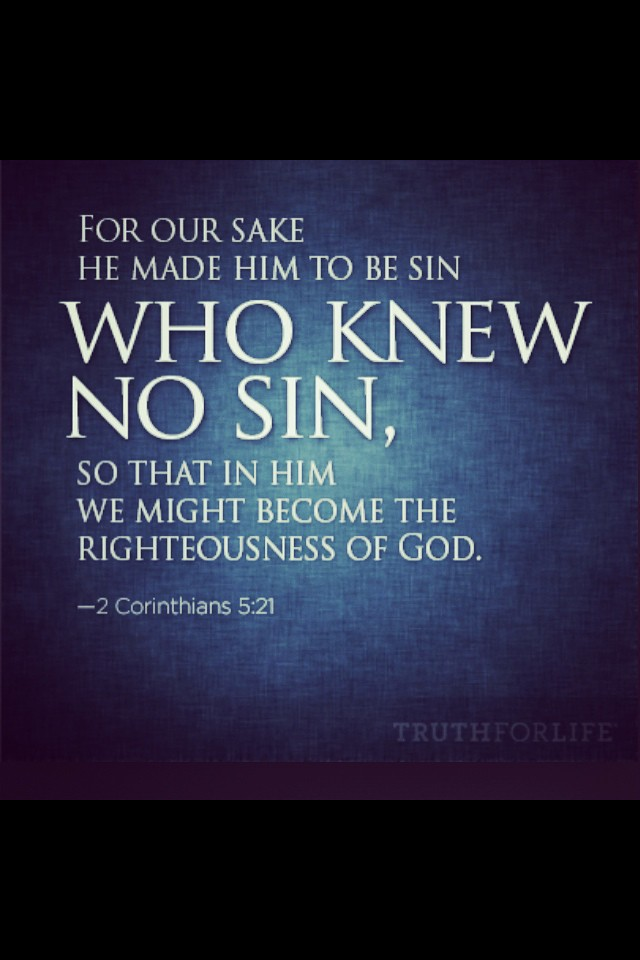
2 Cor 5 21

A theme is defined as the main thrust of what is being promoted, discussed or described. Its purpose is to help people remember the key messages or takeaways from whatever is being talked about. We find prominent themes used for many things such as movies, lectures and writings. We find themes in business, in advertising and in politics. We even find themes in the church as there is often a primary theme for each year, for individual sermons or a sermon series.

Of all the verses in Scripture, I’m not sure there’s a single verse that captures the overall theme of the Bible better than 2 Corinthians 5:21. Personally, it’s my favorite verse. I can still remember when I first grasped the meaning of this verse and the freedom that came with it. That Jesus was my substitute—that He would take the penalty for my sin so I wouldn’t have to just blew me away.

Sometimes in my writing, I wonder if I reference 2 Corinthians 5:21 too much. I wonder if because I love this verse so much, I force its use when it doesn’t belong, where perhaps it doesn’t fit the context of what I’m writing about. But the more I think about it, the truth is, this verse belongs everywhere. Its theme can never be repeated enough. That’s because these twenty-four words take us straight to the cross, the center of all that God has done for us.

There is no greater expression of God’s love than what we find at the cross. On the cross, Jesus not only took our sin, but also the guilt and shame that goes with it. There’s freedom in that, not freedom to sin, but freedom to live in response to His grace. I don’t think we can even begin to fully grasp the depth of God’s love, and for what He has done for us in Christ. Christ’s atoning work has saved us from an eternal hell our sin deserves. But more than that, He has saved us to a living hope, a hope we are to enjoy today, but also to look forward to in its fullness for all eternity.

Shelter from the Storm

“He who dwells in the shelter of the Most High will abide in the shadow of the Almighty” (Psalm 91:1)

Outside of checking the local forecast, I don’t normally watch the Weather Channel. The one exception is if I happen to come across an episode of Storm Stories while channel surfing. I find some the episodes having to do with hurricanes and tornadoes particularly fascinating. The intensity of these storms is amazing. Hurricanes are those slow-moving storms so deliberate in their approach that unless you have personally experienced one before, you may not believe it could be so powerful. That is, until it arrives with all its fury. On the other hand, tornadoes are often right on top of you before you even realize it. Though radar detects their risk, there can be little time to prepare. And what about the devastation they can cause in just a matter of minutes? Images from these episodes on the Weather Channel make it clear the destruction these storms cause. Which one presents the greater risk depends on the area of the country in which you live. Part of how people prepare for these storms is by knowing the best places in their homes to take shelter in hopes of remaining safe and secure until the storm passes.

Safety and security in the midst of adversity is the central theme of Psalm 91, but it’s security that comes from the Lord. The Hebrew word for “dwell” means to be settled. In verse 1, God is referred to as both the “Most High” and “Almighty”. “Most High” emphasizes God’s strength and sovereignty. We are to be settled in the shelter that He alone provides. When God is referred to as “Almighty,” the emphasis is on His self-existence, His activity in the world, and His guardianship over our lives. To “abide” means to remain; a faithful person abides in His “shadow,” shadow being a metaphor for being under the care and protection of the Almighty.

Storms appear in life as well. Maybe they’ve appeared in yours. Life storms don’t discriminate. They don’t care about geography, social status, income, race, gender, or anything else. What kind of storm have you encountered? Was it like a hurricane, that slow-moving and progressive storm, maybe a drawn-out illness you or someone you love is battling? Perhaps it was trouble in your marriage that you and your spouse just can’t seem to get through. Or was your storm like a tornado—the sudden death or disability of a spouse, child, parent, or friend? Maybe it was the job loss you never saw coming. In all these storms, have you ever considered that just maybe you’ve been seeking the wrong shelter? God is powerful and sovereign over any storm. And He loves us greatly. When you and I settle in the shelter that He alone provides, He is pleased to keep us in His shadow and see us through any storm. Believe that! If you’ve been fortunate to thus far be “storm” free, thank God for it, but don’t wait until the storm hits to seek His shelter. Seek it now. There is an amazing rest to be found in God. Seek the only shelter that is truly secure.

Have You Been With Jesus?

“And they recognized that they had been with Jesus” (Acts 4:13)

You’ve probably heard it said, “The apple doesn’t fall far from the true” or “Be careful of the company you keep”. Both statements have to do with influence. Peter and John spent three years at Jesus’ side and there’s no doubt He influenced them greatly. When Jesus told His disciples it was to their advantage for Him to go away, they must have wondered how. He explained that until He did, the Holy Spirit wouldn’t come (John 16:7). It took awhile for the disciples to understand all Jesus meant, but by the time in which we find Luke writing in Acts 4, they do understand. Peter had preached at Pentecost and the Holy Spirit that Jesus promised would come, had come. So, this was a different day, different in the sense that the full indwelling power of the Holy Spirit was present with the disciples. And it was noticeable.

It is not to say that Peter and John had never shown the character of men who had been profoundly affected by the Lord. They had. But Pentecost was pivotal; three thousand people were saved, the early church was born, and it was growing. The book of Acts provides a historical account of the early church, focusing on the apostles’ witness of Christ and the spread of Christianity. It is often referred to as the “Acts of the Apostles”, but may be better described as the “Acts of the Holy Spirit through the Apostles”. It’s true that all spiritual power is the Holy Spirit’s power working in you and me. That was true for Peter and John as well.

In this section of Acts, we find several examples of what resulted from Peter and John having been with Jesus. First, their boldness for Christ in spite of the persecution it brought. When charged by religious leaders not to speak or teach in the name of Jesus, their response was, “Whether it is right in the sight of God to listen to you rather than God, you must judge, for we cannot but speak of what we have seen and heard” (Acts 4:19-20). It was only their being with Jesus that Peter could say salvation comes only though Christ (Acts 4:12). Second, though the religious leaders had plenty of knowledge of the Scriptures they failed to recognize Jesus in them. Peter and John may not have had any formal education, but they were learned in most important thing they could be; Jesus Christ. Third, what Peter, John and all of the disciples accomplished for the cause of the Christian faith resulted from the Holy Spirit’s work in their lives. It was God’s grace and power that led these men in their respective ministries, helping them to endure all that they faced.

There was great value and advantage for Peter and John having Jesus at their side. We have that same advantage. We have the Holy Spirit, God’s inspired Word and full access to Jesus Christ. Sitting at His side will equip you with the accurate message of the gospel. It will also change you. Your faith will cease to be a private affair and you will not be able to help but be bold in your witness for Christ, no matter the consequence. Just as the elders and scribes recognized that Peter and John had been with Jesus when they witnessed their boldness, people will recognize it with you as well. There will be a “family resemblance” people will see as the Holy Spirit works in your life, conforming you to the image of Christ and deepening your love for Him. Can Jesus trust you to accurately proclaim His saving message? Do others know to whom you belong or is it your little secret? Well, let me ask, have you been with Jesus?

Through the Word of Christ

“Faith comes from hearing, and hearing through the word of Christ” (Romans 10:17)

God’s Word is so vast that our full understanding will always remain elusive. That’s why He is God. Just as He has foreordained salvation, God has also foreordained the means by which it comes. Romans 10:17 tells us the only way to come to faith is to hear the gospel—the good about Jesus Christ. That was Paul’s message to the Jews. Though many rejected the gospel, Paul continued to proclaim that their salvation came the same way everyone else’s did, through Christ alone. He was all about breaking down the barriers between Jews and Gentiles. They were all one in Christ. Salvation was for anyone who called on the name of the Lord. So, Paul continued to preach.

Romans 10:17 answers the question of why the gospel must be preached, but prior to this verse, with a series of rhetorical questions, he considers the chain of events that lead to salvation, writing, “How then will they call on Him in whom they have not believed? And how are they to believe in Him of whom they have never heard? And how are they to hear without someone preaching? And how are they to preach unless they are sent?” (Romans 10:14-15). Paul went on to make the point that hearing alone wasn’t enough to be saved. They also needed to respond in faith.

We live in a time where fear and discomfort sometimes inhibits our sharing the message of Christ. Let’s face it, when you express the one way of salvation, you risk offending people. But we must be true to the gospel mandate. We must go and tell because the only way for anyone to be saved is to hear and believe. It may be impossible to always know what those we encounter died believing, but we can know if our lives reflected Christ in us, and if we were faithful to share our reason for hope with them. Be faithful to heed the words of Scripture. These are not just words for us to believe, but words to share like there’s no tomorrow. We can never know, for some, there may not be a tomorrow and eternity is at stake.

Draw Near

“Let us then with confidence draw near to the throne of grace, that we may receive mercy and find grace to help in time of need” (Hebrews 4:16)

The “Christ alone” message challenges us to let go of what comes most natural to our human nature— control. God appointed Christ to suffer and pay the penalty for our sin. It was a debt we couldn’t pay, but one that Jesus lovingly paid on our behalf. Christ has redeemed us, perfectly and for all time. All of salvation is by God’s grace, and it comes through faith alone in Christ alone. Jesus lived a life we couldn’t and He died a death we wouldn’t. We don’t have to add to what Christ has done because we can’t. Instead, we are to trust in His finished work.

As believer’s, our confidence to “draw near” is not because we’ve worked up enough goodness in and of ourselves to be worthy enough to draw near. No, it’s because Jesus, our Great High Priest has made atonement for sin and thereby opened the doorway to grace. It’s Christ who is worthy! So, let us do as the Hebrew writer says. Let us draw near to the throne of grace, and to the cross, the central symbol of all Christ has done on our behalf. We don’t have a God who is unapproachable, but one who calls us to come boldly and confidently before His throne knowing that it’s there where we will find mercy, ever flowing grace, and help in our time of need.

Why “Being Good” Can’t Be Good Enough

“All have turned aside; together they have become worthless; no one does good, not even one” (Romans 10:12)

I imagine all of us at some point have wished that “being good” was good enough to spend eternity with God. There are people we love that one day leave this world making us wonder if they ever put their trust in Jesus Christ. And even with the best of intentions, we wish God would grant salvation based on their “goodness”. The problem in wishing that is it’s not what the Bible teaches. To think otherwise is to misunderstand the relationship between the Old and New Testaments, to ignore numerous passages of Scripture and to read others out of context. Our beliefs must conform to God’s inerrant Word.

The Bible teaches that we’re saved by faith alone in Christ alone. That is the distinguishing characteristic between Christianity and all other religions. The Bible says that “none is righteous, no, not one” that “no one seeks God” and that “no one does good, not even one” (Romans 3:10-12). And about our righteous deeds it says, they’re like filthy rags (Isaiah 64:6). God really is that holy and we all fall short of the perfect standard He set, “For all have sinned and fall short of the glory of God” (Romans 3:23). But thankfully, God didn’t leave us in that condition. By His grace, He has provided a way of salvation for us in Christ. Our stains have been washed clean by the blood of Christ (Ephesians 2:13). Jesus willingly traded His righteousness for our sin (2 Corinthians 5:21) and by His wounds we have been healed (1 Peter 2:24). This is the message we share. This is the good news. This is the gospel. Let these truths never be lost. Though perhaps we might sometimes wish salvation rested on our goodness, the Bible clearly teaches it doesn’t. Salvation results from one thing—trusting in the finished work of Christ, because, unlike us, He was good enough!

A Mighty Fortress

“God is our refuge and strength, a very present help in trouble” (Psalm 46:1)

Most know Martin Luther as the leader of the Protestant Reformation. If you were to associate Luther with only one book of the Bible, it would probably be Romans. His conversion resulted from its study. But Martin Luther also loved the psalms and Psalm 46 was one of his favorites, serving as inspiration for his writing the hymn, A Mighty Fortress Is Our God. Continue reading

The Reluctant Prophet

“But Jonah rose to flee to Tarshish from the presence of the LORD” (Jonah 1:3)

I guess you could call Jonah a reluctant prophet. I imagine to some degree, all the prophets of the Old Testament were. Confronting sin is difficult and that’s what prophets did. God raised them up to call the people of Israel to repent of their sin and return to covenant faithfulness. As difficult as it may have been for Jonah to preach and confront the sins of his own people, imagine his shock when God called him to preach to the people of Ninevah, Israel’s enemy. They were evil. Upset at the mission God gave him, Jonah fled. When God said go east (to Ninevah), Jonah instead went west (to Tarshish), eventually ending up in the belly of a fish (Jonah 1:17). God pursued, preserved and delivered Jonah. He eventually preached to the people of Ninevah and they repented. Though grateful for his own deliverance, Jonah was angered at God’s compassion toward the Ninevites. God had more to teach him. Continue reading