Deathbed Conversions

“And he said, ‘Jesus, remember me when you come into your kingdom.’ And he [Jesus] said to him, ‘Truly, I say to you, today you will be with me in Paradise’” (Luke 23:42-43)

Sometimes we hear of conversions at the end of a person’s life and question their validity. This is particularly the case when that person has done horrible things and are now facing the consequences of their actions. We think that perhaps they’re looking for sympathy for having to suffer those consequences, maybe even hoping with enough sympathy they may even avoid the ultimate consequence, death itself. I guess it’s hard to know for sure if to claim Christ in that moment was genuine or not. Quite frankly, I find myself a little skeptical when I hear stories like this. Perhaps I shouldn’t because the truth is, we have no idea what means God may use to save a soul. And the story of the thief on the cross, I believe, illustrates that very point.

The gospel of Luke gives us the greatest detail about the crucifixion of Jesus. It is also the only gospel account that specifically tells of His interaction with the thief that hung beside Him. Jesus was crucified between two criminals. As people passed by, they mocked and railed against Jesus. One of the criminals joined in “Are you not the Christ? Save yourself and us!” (Luke 23:39). Jesus didn’t respond, but the other criminal rebuked him, saying, “Do you not fear God since you are under the same sentence of condemnation? And we indeed justly, for we are receiving the due reward of our deeds; but this man has done nothing wrong” (Luke 23:40-41). He then turned to Jesus and said “Jesus, remember me when you come into your kingdom.” Jesus’ responded saying “Truly, I say to you, today you will be with me in Paradise” (Luke 23:42-43).

What an amazing story of God’s grace. There’s so much we can learn from the story of the thief on the cross. The first is how gracious God is in spite of our sin. In the case of the thief on the cross, most likely, a lifetime of sin. Salvation for this man was Jesus’ gracious gift to him. It was free. His sins were forgiven because the One hanging next to him was bearing the penalty for it at that very moment. The second lesson is that we don’t have to have lived a perfect life to be saved. We can’t. For the thief on the cross, it was nothing more than a simple expression of faith at the end of his life. A final lesson from the story of the thief on the cross is that we should never give up on sharing the gospel. Just as God has ordained who will be saved, He has also ordained the means and the time of salvation. It was the reality of impending death that proved to be the event God used to save the thief on the cross. God’s timing is always perfect. Let’s not presume to know who is beyond His grace. Just be thankful that Christ has paid the penalty for your sin. Salvation doesn’t rest on a lifetime of goodness, but comes only by grace through faith in Christ. Let this be an encouragement to share that truth with those whose lives seem contrary to deserving the grace our God gives.

Eternally Secure

“For I am sure that neither death nor life, nor angels nor rulers, nor things present nor things to come, nor powers, nor height nor depth, nor anything else in creation, will be able to separate us from the love of God in Christ Jesus our Lord” (Romans 8:38-39)

The lyrics go, “No power of hell, no scheme of man, can ever pluck me from His hand; Till He returns or calls me home, here in the power of Christ I’ll stand.” I love the song In Christ Alone. Not just these words, but the whole song is so rich with the truth of the gospel. It was Christ alone who paid the full penalty for our sin in order to make us right with God. Jesus’ sacrifice on the cross atoned for the sin that separated us from God. As a result, there’s nothing that can ever separate us from the love of Christ. No passage in Scripture makes this truth more clear than does Romans 8:38-39.

There will always be aspects of God and His work in salvation that we’ll never be able to wrap our minds around. “Oh, the depth of the riches and wisdom and knowledge of God! How unsearchable are His judgments and inscrutable (beyond finding out) His ways” (Romans 11:33). When people think of salvation, sometimes they have in their mind that God does His part and we do ours, but that’s not the testimony of Scripture. Ephesians 2:8-9 says, “For by grace you have been saved through faith. And this is not your own doing; it is the gift of God, not a result of works, so that no one may boast.” It’s good for us that salvation is God’s gift and that it doesn’t depend on us, because if it did, we would surely lose it. Think about it, if we could earn salvation what would make us think we couldn’t lose it.

There’s another reason it’s beneficial that salvation comes by faith alone. Let’s face it; no matter our level of spiritual maturity, there are times in all of our lives when we don’t feel saved, times when we don’t feel like God is present. But just as feelings aren’t the basis of God’s truth, they aren’t the basis of our salvation either. Salvation is based solely on the objective reality of what God has done for us in Christ. To believe Jesus paid less than the fully penalty for sin for all time is to deny the truth of the gospel. There is no joy in that, there is no security in that, and lastly, there’s no God in that!

No Hope, Without God…But Now

“But now in Christ Jesus you who were once far off have been brought near by the blood of Christ” (Ephesians 2:13)                                                                                                                                                  

In April, I began reading Ephesians. My plan has been to read the whole book every day for the month. The idea came from a friend who told me about an article written by John MacArthur on the topic of how to read the Bible for a deeper level of understanding. As I’ve been reading, Paul’s teaching in Ephesians 2:12-13 has been particularly meaningful. What the apostle is teaching in these verses is the unity and peace that exists in Christ. In context, he is teaching that the Jews and Gentiles are no longer two distinct groups, but are one “new man” in Christ. This is a pretty amazing considering the social and spiritual disadvantages the Gentiles had relative to the Jews. You see, the Gentiles weren’t part of the covenant community. They weren’t given a divine promise. They didn’t even recognize the true God. So, in fact, they were without hope and without God. But you know what, so were we.

Sometimes it’s easy to fall into a casual approach to reading God’s Word. It’s like we treat it as if it’s part of our “to do” list as opposed to an opportunity to meet with our heavenly Father. I believe this is particularly the case if we’ve studied the book or passage before. We assume there’s nothing more to be gained from it. It is true that a verse says and means only one thing, and it’s true that it says and means the same thing every time we read it. But it is equally true that the Holy Spirit is capable of taking God’s Word and impressing it upon our hearts in different ways at different times. That’s what’s happened as I’ve been reading through Ephesians this month. I’ve read Ephesians many times, but what has really struck me this time is that the Gentiles story is my story. And it’s also your story. All of us were without hope and without God. The Bible says we were dead in our trespasses and sins (Ephesians 2:1). But then God intervened, and because of His mercy and grace, even when we were dead in our trespasses, He made us alive together with Christ (Ephesians 2:4-5). Christ’s substitutionary death was not only for the Jew, but also for the Gentiles. It was for us as well. Christ’s death for us is the greatest expression of love ever known. It brought near those who were once far off. I believe the “But now” in each of our lives means even more when we realize our desperate condition apart from Christ. How can we truly appreciate grace if we’re oblivious to the degree with which we need it? God doesn’t love us because we’re lovable. He chooses to love us simply out of His own free will. The cross is the proof. Let us respond by loving Him in return.

Grieving with Hope

“But we do not want you to be uninformed, brothers, about those who are asleep, that you may not grieve as others do who have no hope” (1 Thessalonians 4:13)

Sometimes the testimonies of God’s grace are overwhelming. To see others worship God in the midst of their pain is amazing. Suffering of any kind is a harsh reality of life. Suffering that leads to death is an even harsher reality. I think the Bible speaks so much about suffering because of its prominence in our world. No one is immune to suffering and when it happens it’s easy to ask why. Why does a young child die? Why does death occur so suddenly that there’s no time for goodbye? Or why does a lifelong of suffering have to precede death? For that matter, why does death occur at all? Scripture helps us to know that death is not normal, but is a consequence of The Fall. But Scripture also helps us to know that for those who are in Christ, death ultimately brings life.

The emphasis of 1 Thessalonians 4:13 is that although grief is a completely normal reaction to death, Christians grieve with the hope of knowing that one day a reunion with their loved ones will follow. The people in the church at Thessalonica were concerned that their loved ones who had already died would miss out on the Lord’s return. Paul taught them and is also teaching us about the proper perspective and response to death. This teaching should never be taken to mean Christians are not to grieve.

It’s a privilege to be able to see people live out their faith in difficult times. To watch them trusting in God’s promise that He works all thing together for good, to believe the truth that suffering can’t compare to glory, and to testify that there is a peace, the peace of God which surpasses all understanding (Romans 8:28, Romans 8:18, Philippians 4:7). Wow! To say it’s a privilege is not to say we wouldn’t have preferred them not suffer loss and have to grieve at all. It is only to say it’s a privilege in the sense of seeing the Holy Spirit do in and for them what only He can do.

One of the primary roles of the church is to strengthen the body of Christ. This happens when we’re taught God’s Word, but I think sometimes even more so when we witness it lived out. It happens when we see those who are suffering because of their loss, clinging to God and His Word, proclaiming not only that He is great, but that He is good, even in spite of the fact that so much of what has happened may tell them differently. This is the Spirit’s work. It is something those apart from Christ cannot know. I believe the Spirit of God uses these people to show others of us where we may be lacking in our own faith; while at the same time providing encouragement by storing up their testimonies in our hearts should our paths ever take a similar route.

God is so gracious. He is good all the time. Dig deep in His Word to know Him more. Don’t face the harshness of this world and the reality of suffering and death without Him at your side. Seek the peace and hope that He alone provides. One day death will come for all of us, but for those who have placed their hope in Christ; it’s really just the beginning.

Cassie: A Good Gift from God

“Every good gift and every perfect gift is from above…” (James 1:17)

IMG_0642On November 3rd a “Facebook memory” appeared on my profile page. It was from 2 years ago and was a picture of our dog Cassie. November 3rd is her birthday. Cassie died on January 11th of this year. She was such a part of our daily lives. I realized that more fully when I set off the alarm a few times in the morning that first week because she wasn’t there to remind me to turn it off so I could let her out. It was also strange not having her occasionally greet me on the driveway when I pulled up, beg by the dinner table, or if not outright begging, stare me down when I ate, waiting for me to give her a sign that it was okay to come get a bite. All of a sudden, things you took for granted, you wish you could have back.
God’s word tells us that every good and perfect gift is from God (James 1:7). I think it’s pretty easy to over spiritualize certain things that happen. I try hard not to do that. I guess that’s why it’s taken me so long to put into words what’s been on my mind for quite some time. I even had a few conversations with friends to get their opinion about whether, if in the case of Cassie, I was doing what I try and guard against. I’ve also hesitated in writing this because I know some who have lost much more. However, the more I’ve thought about it, I don’t think it’s an over spiritualization at all. Cassie was a source of joy and a blessing to our family. She taught us a lot about love and loyalty. She was a gift. God was the giver. Sometimes I think it’s easy to forget from whom it is ultimately that the joys and blessings in life come.

There is a theological term called “common grace”. Common grace is “the grace of God by which He gives people innumerable blessings that are not part of salvation”. It is grace given to both believers and unbelievers. I don’t know if Cassie’s death made me more sensitive to it or not, but I’ve noticed many postings from people who have also had to say goodbye to their pets this year. I remember experiencing personally in the case of our losing Cassie, and reading in other cases, the many kind expressions of sorrow from others. Some of these expressions came from people who believe differently than me on a whole host of issues. Fortunately or unfortunately, you learn those things from Facebook too. But in some things, our differences don’t seem to matter and we see God’s common grace shine through. I think these expressions of sorrow and encouragement that our family experienced and the expressions I read in other cases are just that, a display of God’s common grace.

As 2015 comes to a close, it will soon be a year since Cassie has been gone. We miss our little Cassie, but will always cherish the 13 years we had with her. In many ways, I think she taught us more than we taught her. I’m sure we are not alone in either our missing or our learning. I am reminded of one of the conversations I had with a friend where he told me they used to have a ceramic piece that hung in their kitchen above the sink. It was a silhouette of a dog. Painted on it was a prayer that read, “Lord, make me the person my dog thinks I am”. We would do well to let that be our prayer even now

Thankful

“Rejoice always, pray without ceasing, give thanks in all circumstances; for this is the will of God in Christ Jesus for you” (1 Thessalonians 5:18)

As part of our Thanksgiving service at church each year, we have the opportunity to hear testimonies of God’s work in people’s lives. At some point in the service we are always reminded that whether our current circumstance has on the top of the mountain or in the deepest of valleys, God is the author of both. The theme verse for this service is 1 Thessalonians 5:18.

Let’s face it; it’s easier to give thanks in certain circumstances than others, but God’s Word says we are to give thanks in ALL of them. What Paul writes in 1 Thessalonians 5:18 has a tendency to strike us the same way as when James writes, “Count it all joy…when you meet trials of various kinds” (James 1:2). The call to obey is clear, but obedience to that call is easier said than done. In fact, without the power and presence of the Holy Spirit, it’s impossible.

Over the last couple of years, many of the testimonies in this Thanksgiving service have been from people dealing with difficult and often uncertain circumstances in their lives. But in spite of that, they testify to God’s faithfulness and grace. I always leave this service encouraged yet reminded that the problems I have aren’t really problems at all.

God’s love and faithfulness is threaded throughout the Bible. That love was demonstrated most clearly in the person of Jesus Christ. The apostle Paul wrote about the importance of joy and contentment not being based on our circumstance, but rather on our relationship with Christ. He also demonstrated it in his life. Paul prayed less about a change in his circumstance, only that he would glorify God through whatever circumstance in which he found himself. He trusted that God could take any circumstance and work it for good. And though he may not have known why what was happening was happening, he knew there was a purpose behind it (Romans 8:28-29). So, when we give thanks during this year, let us remember how much we have to be thankful for. Let us remember that it’s not only on the mountaintop that God is faithful, but also in the valley. Let us remember that the Author of our circumstance has also written its ending. It is in that truth we rest our hope and give our thanks!

Right in Our Own Eyes

“In those days there was no king in Israel. Everyone did what was right in his own eyes” (Judges 21:25)

This last verse of Judges pretty much sums it up. The people set the rules. Though Israel’s drift away from God had already begun, by the time of the judges, their turning away was pretty well complete. The book of Judges was written around 1043 B.C. just after Saul, Israel’s first king, began his reign and spans a period of about 350 years. It is one of the twelve “historical books” books of the Bible. Though its author is unknown, they are thought to be a loyal supporter of David.

“And the people of Israel did what was evil in the site of the LORD…” These words are written numerous times in the book of Judges (2:11; 3:7; 4:1; 6:1; 10:6; 13:1). Israel was in both a moral and spiritual decline. Their disobedience was rampant. They refused to drive their enemies from the land, they committed idolatry, they refused to listen to the advice of the “judges” and they turned away from God after the particular judge’s death. The result of their disobedience was conflict and turmoil. God, however, was gracious, and when Israel expressed their desperation and acknowledged their sinfulness, He would send another judge to deliver them. This pattern played itself out over and over again during this period.

Too often we want to do what is right in our own eyes without proper concern for God’s will. This never gets us very far and it is only when we reap what we have sown that we acknowledge our sinfulness. The truth is we are not too different from Israel in that regard. But thankfully, our God is different and in the book of Judges we see His character on full display. Yes, God is righteous, wrathful and just. There were consequences that resulted from Israel’s disobedience. There are consequences that result from our disobedience as well. But our God is also a loving God. He is merciful and gracious, and just as He heard Israel’s cry, He also hears ours. And just as He delivered them from their failures time and time again, He stands ready to deliver us from ours. We will spend our lives learning more and more about God’s character. As we do, let us call on the power of the Holy Spirit to help us lead lives in submission to God’s will. Let us do what is right in His eyes only.

About Sin

“For all have sinned and fall short of the glory of God” (Romans 3:23)

The fact that we are all sinners is clearly taught in Scripture. Speaking to both Jews and Gentiles, Paul spent the first two and a half chapters making the case that all have sinned and fallen short of God’s glory. Known as the Apostle Paul’s most theological letter, Romans spells out the whole of the gospel more than any other letter. It’s not an accident that in doing so, he began with sin.

There are two dangerous attitudes toward sin that we need to be cautioned against. The first is the attitude that shrugs off sin with words like, “I’m just a sinner; God knows that”. While we are sinners, and yes, God does know that, our attitude toward sin matters. God has commanded us to “be holy, for I am holy!” (1 Peter 1:16). A casual attitude toward sin never brings glory to God. A second dangerous attitude toward sin is an attitude that believes we are incapable of great sin. It is often manifested by judging someone else by saying something like, “I can’t believe what they did. I would never do that.” Be careful, we all have a sin nature and are capable of great sin. If you believe you’re not, you’ll be less likely to guard against it. The Christian life requires discipline. We must train ourselves for godliness (1 Timothy 4:7).

I once heard a sermon where a pastor in preaching to prospective pastors in seminary training said that if in their preaching they do not confront their congregation about sin, it not only brings into question their love for their congregation, but also their love for God. When your pastor confronts you with your sin, be grateful. He’s preaching the Bible. However, also know that the natural extension of confronting you with your sin is for him to tell you of its cure, Jesus Christ. It has been said that “the first act of faith is to believe what God says about sin”. It’s true. And what brings people to saving faith is what God did about it. He gave His Son to pay sin’s penalty. Have you placed your faith in that truth? Jesus really did pay it all. He paid it willingly, perfectly and for all time. After such a display of love, how could we be so casual about what Christ came to cure?

Walking in What?

“This is the message we have heard from him and proclaim to you, that God is light, and in Him is no darkness at all. If we say we have fellowship with Him while we walk in darkness, we lie and do not practice the truth” (1 John 1:5-6)

No one dealt more directly in their writing about what should be the character of a Christian than the apostle John. The Bible doesn’t teach that we should be in constant doubt of our salvation, but it also does not teach that a life devoid of obedience to the will of God is testimony of saving faith.

In the first chapter of 1 John, the apostle uses light and darkness to contrast those who are real versus those who aren’t. In Scripture, “light” refers to biblical truth whereas “darkness” signifies error.  When we walk in light (in truth and holiness), we affirm God’s work in us. When we walk in darkness (in sin), we affirm the opposite.

The apostle John doesn’t pull any punches in his letters. The truths about character and faith are ones we must confront. He was not alone in his teaching that sin cannot be the pattern of our lives if our testimonies are to be true. The apostle Paul spoke clearly on this issue as well (Romans 6:1-2). Though sin will be an ever present enemy and a tool Satan will use against us, our union with Christ and the Holy Spirit’s presence in us has broken its power. The Bible tells us that “there is therefore now no condemnation for those who are in Christ Jesus” (Romans 8:1). At the same time it says, “Examine yourselves, to see whether you are in the faith” (2 Corinthians 13:5). Our pattern of life should always be consistent with our profession.

So, what is the pattern of your life? Are you moving more and more toward Christ? Though never perfect, is your heart set to do God’s will? Let us examine our lives to see if our practices line up with what we say we believe. And let our hearts long for obedience to the will of God in response to His magnificent grace.

A Repeating Theme

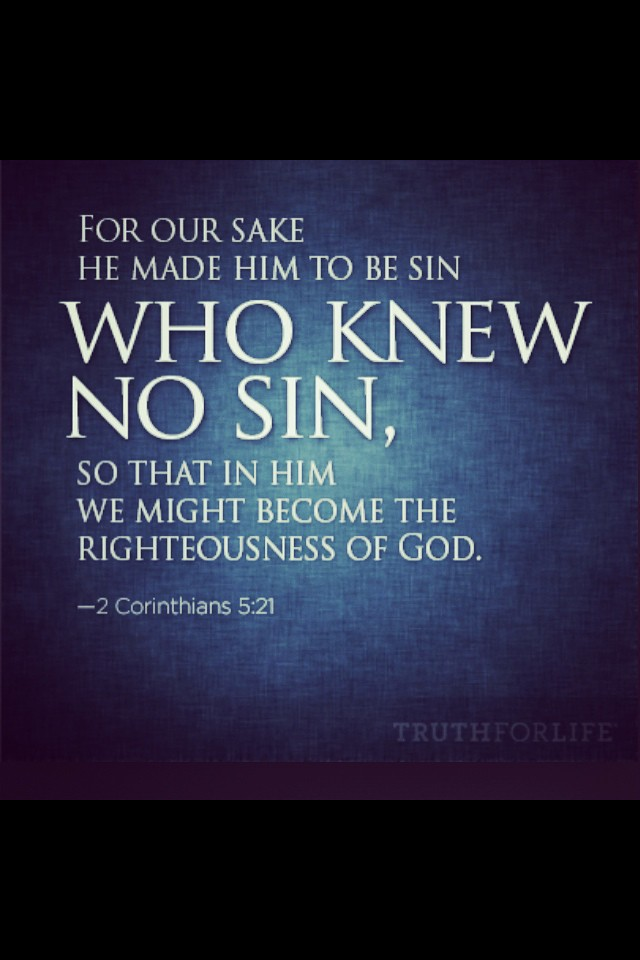
2 Cor 5 21

A theme is defined as the main thrust of what is being promoted, discussed or described. Its purpose is to help people remember the key messages or takeaways from whatever is being talked about. We find prominent themes used for many things such as movies, lectures and writings. We find themes in business, in advertising and in politics. We even find themes in the church as there is often a primary theme for each year, for individual sermons or a sermon series.

Of all the verses in Scripture, I’m not sure there’s a single verse that captures the overall theme of the Bible better than 2 Corinthians 5:21. Personally, it’s my favorite verse. I can still remember when I first grasped the meaning of this verse and the freedom that came with it. That Jesus was my substitute—that He would take the penalty for my sin so I wouldn’t have to just blew me away.

Sometimes in my writing, I wonder if I reference 2 Corinthians 5:21 too much. I wonder if because I love this verse so much, I force its use when it doesn’t belong, where perhaps it doesn’t fit the context of what I’m writing about. But the more I think about it, the truth is, this verse belongs everywhere. Its theme can never be repeated enough. That’s because these twenty-four words take us straight to the cross, the center of all that God has done for us.

There is no greater expression of God’s love than what we find at the cross. On the cross, Jesus not only took our sin, but also the guilt and shame that goes with it. There’s freedom in that, not freedom to sin, but freedom to live in response to His grace. I don’t think we can even begin to fully grasp the depth of God’s love, and for what He has done for us in Christ. Christ’s atoning work has saved us from an eternal hell our sin deserves. But more than that, He has saved us to a living hope, a hope we are to enjoy today, but also to look forward to in its fullness for all eternity.